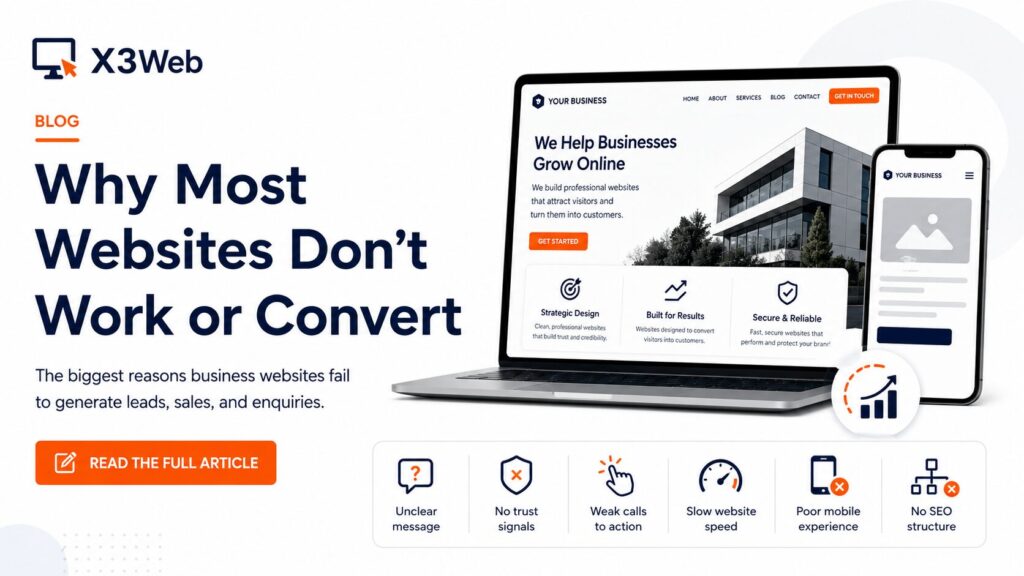
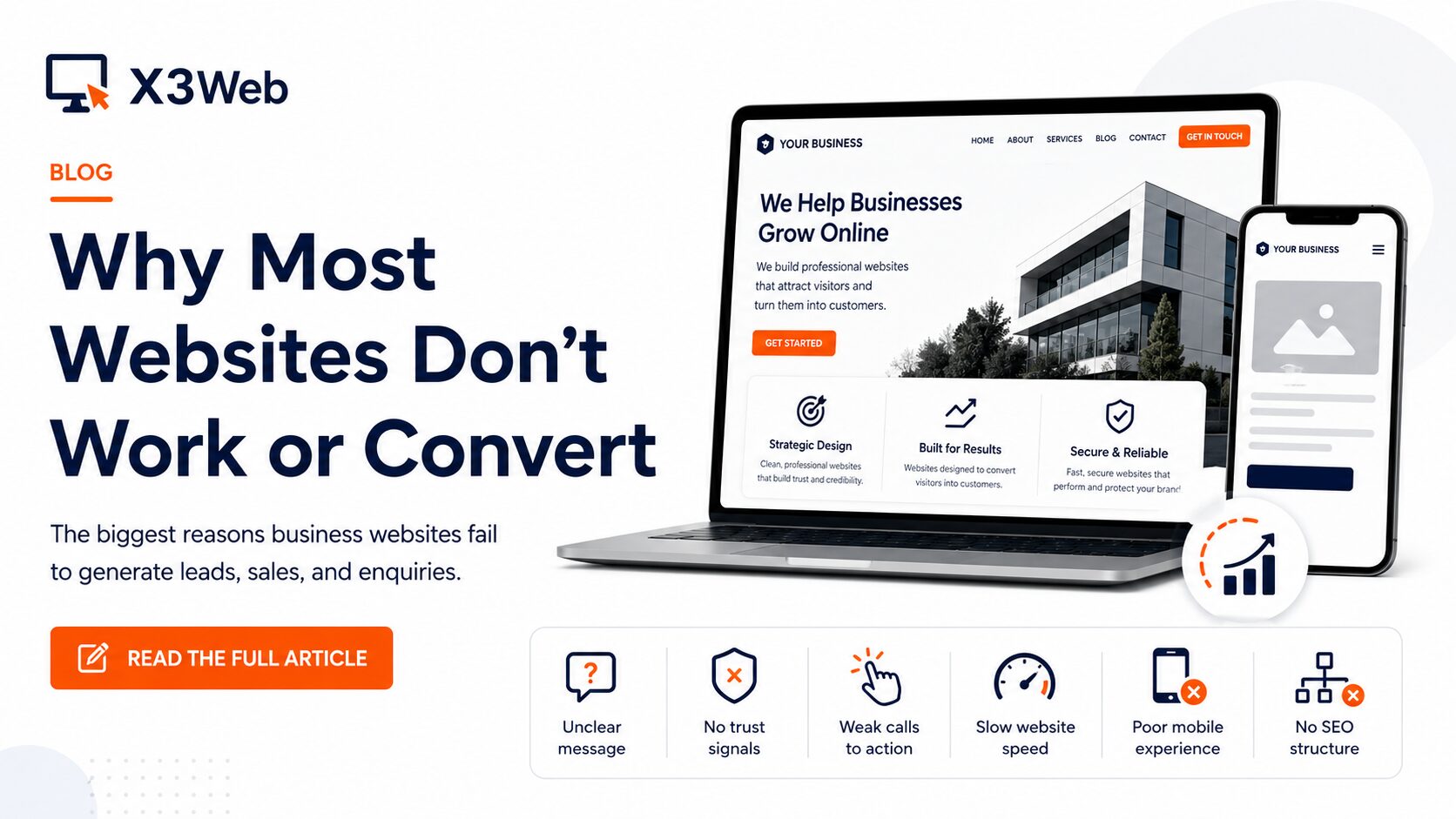
A website can look good and still fail.
Many business owners think a website is working just because it is online. But a website is not there to simply exist. It must attract the right people, build trust, explain the offer clearly, and guide visitors to take action.
If a website is not bringing in leads, sales, bookings, calls, or enquiries, something in the structure is broken.
Below are the most common reasons websites do not work or convert.
1. The message is not clear
Visitors should understand your business within a few seconds.
They need to know:
- What you do
- Who you help
- What problem you solve
- Why they should trust you
- What they must do next
If your homepage uses vague wording like quality solutions, trusted service, or professional excellence without explaining the actual offer, people get confused.
A confused visitor does not become a customer.
Your website must answer this quickly:
- What is being offered?
- Why does it matter?
- Why should the visitor choose this business instead of another one?
2. The website does not build trust
People do not enquire, book, or buy if they do not trust the business.
Trust is built through clear proof, professional presentation, and useful information.
Common trust problems include:
- Poor design
- Old-looking layout
- Blurry images
- No reviews
- No testimonials
- No real business photos
- No phone number
- No visible email address
- No business location where relevant
- No company information
- Broken links
- Spelling mistakes
- Generic stock images
- No proof of previous work
Your website must make the visitor feel safe.
They need to believe:
- This business is real
- This business can help me
- Other people have used this business
- I will not regret contacting them
3. There is no strong call to action
A call to action tells the visitor what to do next.
Examples include:
- Get a Quote
- Book a Consultation
- Call Us Today
- Send an Enquiry
- View Our Packages
- Buy Now
- Request a Callback
Many websites hide the main button or use weak buttons like Learn More everywhere.
That is a problem.
A website must guide people clearly. If you want leads, the enquiry button must be obvious. If you want calls, the phone number must be easy to tap. If you want bookings, the booking process must be simple.
Every important page should have:
- A clear primary button
- A visible contact option
- A reason to take action
- A simple next step
Without this, visitors may like the website but still leave without doing anything.
4. The website is too slow
A slow website kills conversions.
People are impatient online. If the page takes too long to load, many visitors leave before they even see the offer.
Common reasons websites are slow:
- Large image files
- Poor hosting
- Too many plugins
- Heavy animations
- Uncompressed videos
- Bloated themes
- Too much unnecessary code
- No caching
- Poor mobile optimisation
Speed matters because it affects:
- User experience
- Google rankings
- Ad performance
- Bounce rate
- Lead generation
- Online sales
A website must load quickly, especially on mobile.
5. The mobile experience is bad
Most people browse websites on their phones.
A website that looks good on desktop but feels terrible on mobile will lose leads.
Common mobile problems include:
- Text is too small
- Buttons are hard to tap
- Sections overlap
- Images crop badly
- Forms are difficult to complete
- Menu is confusing
- Pages load slowly
- Important buttons are hidden
- The contact number is not clickable
Mobile visitors want fast answers.
They should be able to:
- Read easily
- Scroll smoothly
- Tap buttons easily
- Call quickly
- Send an enquiry without frustration
- Understand the offer without zooming in
If the mobile version is weak, the website is weak.
6. The website has poor navigation
Navigation helps visitors find what they need.
If your menu is confusing, people leave.
Bad navigation usually includes:
- Too many menu items
- Unclear page names
- Important pages hidden
- No contact button
- No service categories
- No logical structure
- Too many dropdowns
- Pages that lead nowhere
Good navigation should be simple.
A strong website menu usually includes:
- Home
- About
- Services
- Portfolio or Work
- Reviews or Testimonials
- Blog or Resources
- Contact
For e-commerce websites, navigation should also include:
- Clear product categories
- Search functionality
- Filters
- Cart access
- Account access
- Checkout access
The easier the website is to use, the better the chance of conversion.
7. The website talks too much about the business
Many websites make the mistake of talking only about themselves.
They say:
- We are passionate
- We are professional
- We have years of experience
- We offer quality service
- We are your trusted partner
That is not enough.
Customers care about their own problems first.
They want to know:
- Can you solve my problem?
- Can I trust you?
- How much does it cost?
- How long will it take?
- What do I get?
- What happens after I contact you?
- Why should I choose you?
Your website copy must focus on the customer.
Better messaging speaks about:
- The customer’s problem
- The result they want
- The pain they want to avoid
- The value of your service
- The reason your business is the right choice
People convert when they feel understood.
8. There is not enough proof
A website without proof is just making claims.
You can say you are the best, reliable, professional, or trusted, but the visitor needs evidence.
Strong proof includes:
- Google reviews
- Testimonials
- Case studies
- Before and after examples
- Portfolio projects
- Client logos
- Screenshots of results
- Video testimonials
- Certifications
- Awards
- Years of experience
- Team photos
- Project photos
Proof reduces doubt.
It shows visitors that:
- Other people trust you
- You have done this before
- You can deliver
- Your business is legitimate
- There is less risk in contacting you
If you want more conversions, add more proof.
9. The offer is weak or badly presented
Sometimes the website design is not the real problem. The offer is.
A weak offer is difficult to understand or does not feel valuable.
Common offer problems include:
- Services are listed with no detail
- No packages
- No pricing indication
- No explanation of value
- No clear deliverables
- No process
- No guarantee or reassurance
- No reason to act now
- No difference from competitors
A strong offer should explain:
- What is included
- Who it is for
- What problem it solves
- What result the customer gets
- Why it is valuable
- How the process works
- What makes it better than other options
For example, Website Design is vague.
A stronger offer would be:
Complete business website package with hosting, mobile optimisation, SEO setup, Google indexing, contact forms, and ongoing support.
That is clearer. It feels more valuable.
10. The forms are too long or complicated
Forms can destroy conversions if they ask too much too early.
A visitor may be willing to enquire, but not willing to complete a long form with unnecessary questions.
Common form problems include:
- Too many fields
- Required fields that are not needed
- No clear submit button
- Forms that do not work on mobile
- No confirmation message
- No trust message
- No privacy reassurance
- Forms that feel like admin work
For most service businesses, a simple lead form should ask for:
- Name
- Phone number
- Email address
- Service needed
- Message
You can ask more questions later.
The first goal is to start the conversation.
11. The website has no SEO structure
A website cannot convert if the right people never find it.
Many websites are built with poor SEO structure from the start.
Common SEO problems include:
- No keyword strategy
- Poor page titles
- Missing meta descriptions
- Weak headings
- Thin service pages
- No location targeting
- No internal linking
- No image optimisation
- No schema markup
- No Google Search Console setup
- No indexing check
- No blog strategy
- No proper URL structure
A good website should be built around what customers search for.
For example, a plumbing company should not only have one page called Services.
It should have specific pages such as:
- Geyser Repairs
- Leak Detection
- Blocked Drains
- Bathroom Plumbing
- Emergency Plumbing
- Plumbing Services in Pretoria
- Plumbing Services in Johannesburg
Specific pages rank better and convert better because they match what people are searching for.
12. The website attracts the wrong traffic
Traffic does not always mean business.
A website can get visitors and still generate no leads if the visitors are not the right people.
Wrong traffic usually comes from:
- Poor ad targeting
- Broad keywords
- Weak SEO strategy
- Social media curiosity clicks
- Low-intent blog content
- Wrong geographic targeting
- Misleading ad copy
- Offers that do not match the audience
Example:
Someone searching how to build a website for free is not the same as someone searching professional website designer in Johannesburg.
One wants free information. The other may be ready to buy.
Conversion depends on traffic quality, not just traffic volume.
13. There are too many distractions
A website should guide visitors toward one main action.
Too many distractions make people lose focus.
Common distractions include:
- Too many popups
- Too many buttons
- Too many animations
- Auto-playing videos
- Random sliders
- Too many different offers
- Cluttered sections
- Messy layouts
- Unnecessary text
- Confusing colours
When everything tries to get attention, nothing stands out.
A strong page should have:
- One main goal
- One clear message
- One primary call to action
- Clean section flow
- Enough information without clutter
Simple does not mean boring. Simple means focused.
14. The content is too thin
Thin content gives visitors too little information to make a decision.
A weak service page may only say:
We offer professional roofing services. Contact us today.
That is not enough.
A proper service page should explain:
- What the service is
- Who needs it
- What problems it solves
- What is included
- Why the business is qualified
- How the process works
- What areas are served
- Common questions
- How to get started
The more expensive or important the service is, the more information people usually need before they act.
Thin content also hurts SEO because Google has less context to understand and rank the page.
15. The website does not answer objections
Before people contact a business, they usually have doubts.
Common customer objections include:
- Is this business legit?
- Can I afford this?
- Will they respond?
- Will they deliver properly?
- How long will it take?
- Are there hidden costs?
- What if I am not happy?
- Do they understand my problem?
- Have they helped people like me before?
A good website answers these objections before the visitor has to ask.
You can reduce doubt with:
- FAQs
- Testimonials
- Clear pricing or package guidance
- Process explanations
- Guarantees
- Reviews
- Case studies
- Real photos
- Strong About page
- Clear contact details
If the visitor feels uncertain, they delay action. If they delay action, they often leave.
16. The design does not support conversion
Design is not just decoration.
Design must help the visitor move through the page.
Bad conversion design includes:
- Weak headings
- Poor spacing
- Hard-to-read text
- Low colour contrast
- Buttons that do not stand out
- Important information hidden too low
- No visual hierarchy
- Too many design elements competing
- Sections in the wrong order
Good design creates a journey.
A strong page usually flows like this:
- Clear headline
- Short explanation
- Strong call to action
- Problem section
- Solution section
- Services or offer
- Proof
- Process
- FAQs
- Final call to action
The design should guide the visitor from interest to trust to action.
17. The website feels generic
Generic websites do not stand out.
They sound like every other business.
Generic phrases include:
- We offer quality service
- We are your trusted partner
- We provide professional solutions
- We go the extra mile
- Customer satisfaction is our priority
These phrases are overused and weak.
Specific messaging is stronger.
Instead of saying quality service, explain what that means:
- Same-day response
- Clear pricing
- Experienced technicians
- Certified team
- Custom-built solutions
- Local support
- Detailed project handover
- Reliable after-sales service
Specific details make the business feel more real and believable.
18. There is no tracking
If you are not tracking your website, you are guessing.
A business website should track important actions such as:
- Form submissions
- Phone number clicks
- WhatsApp clicks
- Email clicks
- Purchases
- Add to cart actions
- Checkout starts
- Booking submissions
- Quote requests
Important tools include:
- Google Analytics
- Google Search Console
- Google Tag Manager
- Google Ads conversion tracking
- Meta Pixel
- Heatmaps
- Call tracking where needed
Without tracking, you cannot properly answer:
- Where are the leads coming from?
- Which pages are working?
- Which ads are wasting money?
- Where are people dropping off?
- Which services get the most interest?
- What must be improved?
A website that is measured can be improved. A website that is not measured is just guesswork.
19. The website was built once and forgotten
A website should not be treated as a once-off project.
Businesses change. Customers change. Competitors improve. Google updates. Technology moves forward.
A website should be reviewed regularly.
Things to check often:
- Speed
- Mobile layout
- Broken links
- Contact forms
- SEO rankings
- Website security
- Plugin updates
- Content accuracy
- Service pages
- Pricing or packages
- Testimonials
- Tracking setup
- User behaviour
A website that is not maintained slowly becomes weaker.
20. The website does not match the customer journey
Not every visitor is ready to buy immediately.
Some visitors are:
- Researching
- Comparing options
- Looking for prices
- Checking credibility
- Looking for proof
- Ready to enquire
- Ready to buy
Your website should support all of these stages.
A strong website includes:
- Homepage for first impressions
- Service pages for detail
- About page for trust
- Portfolio for proof
- Testimonials for confidence
- FAQs for objections
- Blog posts for education and SEO
- Landing pages for ads
- Contact page for action
If your website only gives basic information, it may not support people enough to make a decision.
The Bottom Line
Websites do not fail because they exist online. They fail because they are unclear, slow, confusing, untrustworthy, badly structured, or not built around the customer.
A website must do more than look nice.
It must:
- Grab attention
- Explain the offer clearly
- Build trust
- Load fast
- Work properly on mobile
- Answer customer questions
- Remove doubt
- Guide the visitor
- Make action easy
- Track results
- Improve over time
A beautiful website that does not convert is just decoration.
A proper website is a business system.
It should help people understand your value, trust your business, and take the next step. That is when a website starts working.