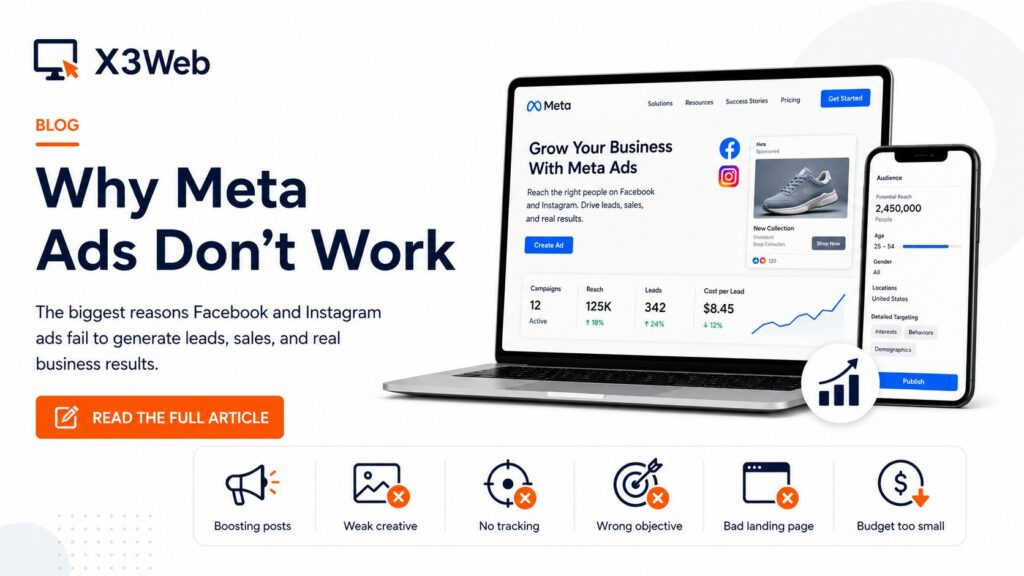
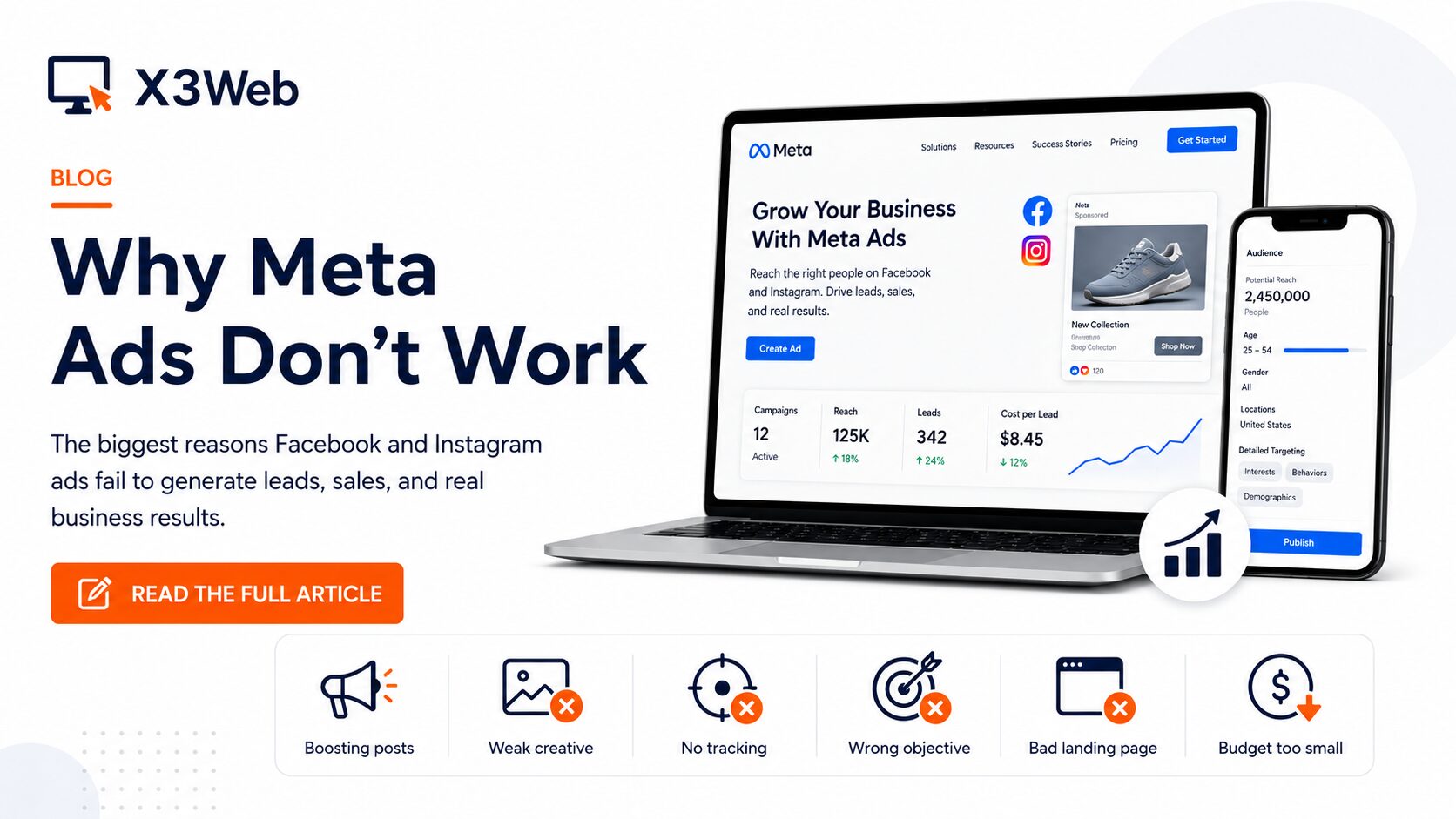
Meta ads can be powerful, but most businesses use them badly.
They boost random posts, spend too little, target the wrong people, ignore tracking, use weak creatives, send traffic to bad websites, and then blame Facebook when nothing happens.
The truth is simple: Meta ads are not magic. They are a system.
If the system is broken, the ads will not work.
A proper Meta ads setup needs:
- A clear offer
- Strong creative
- Proper tracking
- Enough budget
- The right campaign objective
- A working landing page
- Good follow-up
- Time for the algorithm to learn
- Testing and optimisation
If one or more of these parts are missing, the campaign can burn money without producing real results.
1. They boost posts instead of running proper campaigns
Boosting posts is one of the biggest reasons people think Meta ads do not work.
Boosting is easy, but easy does not always mean effective.
When someone boosts a post, they usually choose a basic goal like more engagement, more messages, or more page likes. That can create activity, but activity is not the same as business results.
Boosted posts often bring:
- Likes
- Comments
- Shares
- Cheap engagement
- Random attention
- People who are curious but not serious
But most businesses actually need:
- Leads
- Sales
- Bookings
- Calls
- Website enquiries
- Purchases
- Quote requests
A boosted post usually does not give Meta enough structure to optimise for real conversions. It is more like paying to make a post more visible.
A proper Meta campaign should be built inside Ads Manager with the right objective, tracking, audience, creative, placement strategy, and conversion goal. Meta’s current ad system is becoming more automated through Advantage+ and AI-driven delivery, but it still needs the right inputs to optimise properly. Meta’s own Andromeda system was built to improve ad retrieval and personalisation inside Advantage+ automation, which means Meta is relying heavily on machine learning to decide which ads are most relevant to which people.
Boosting may be fine for visibility, but it is usually not enough if the goal is real leads or sales.
2. They spend too little to get proper data
Many business owners spend R50, R100, or R200 and expect instant results.
That is not how Meta ads work.
Meta needs enough budget to test:
- Different people
- Different placements
- Different times of day
- Different creatives
- Different behaviour patterns
- Different conversion opportunities
If the budget is too small, the campaign cannot gather enough data. The algorithm does not get enough chances to learn who is most likely to take action.
Low budget causes problems such as:
- Not enough impressions
- Not enough clicks
- Not enough leads
- Slow learning
- Unstable results
- No clear winner between creatives
- Poor optimisation data
Meta ads need a testing budget before they become predictable.
A business cannot judge a campaign properly after spending almost nothing. That is like putting one litre of petrol in a car and saying the car does not work because it did not drive far.
The budget must match the goal.
For example:
- Lead generation needs enough budget to generate multiple leads
- E-commerce needs enough budget to generate add-to-carts and purchases
- Retargeting needs enough traffic before it can work properly
- Testing multiple creatives needs enough spend per creative
- Scaling needs stable data before increasing budget
Spending too little does not protect the business. It often wastes money slowly.
3. They do not install the Pixel or Conversions API
This is a massive problem.
If Meta does not know what people are doing after clicking the ad, it cannot properly optimise.
The Meta Pixel tracks website actions from the browser. The Conversions API sends marketing data from the business server or platform directly to Meta. Meta explains that the Conversions API is designed to create a direct connection between marketing data and Meta’s systems to help optimise ad targeting, decrease cost per result, and measure outcomes.
Without proper tracking, Meta may not know:
- Who submitted a form
- Who clicked WhatsApp
- Who called
- Who added to cart
- Who started checkout
- Who purchased
- Which ad produced the result
- Which audience is most valuable
- Which campaign is wasting money
That means the campaign is basically running blind.
A proper Meta tracking setup should include:
- Meta Pixel
- Conversions API
- Domain verification
- Events Manager setup
- Standard events
- Custom conversions where needed
- Lead or purchase tracking
- Thank-you page tracking
- WhatsApp click tracking if relevant
- Call click tracking if relevant
- Event testing before launching
For modern Meta ads, Pixel alone is often not enough. Browser restrictions, privacy changes, cookie limits, and ad blockers can reduce browser-side tracking quality. This is why many advertisers now combine Pixel and Conversions API for stronger signal quality. Adobe’s current Meta Conversions API documentation also describes it as a way to connect server-side marketing data to Meta technologies to optimise targeting, decrease cost per action, and measure results.
No tracking means weak data.
Weak data means weak optimisation.
Weak optimisation means expensive ads.
4. They choose the wrong campaign objective
The campaign objective tells Meta what result to optimise for.
If you choose the wrong objective, Meta will find the wrong type of people.
For example:
- If you choose Engagement, Meta finds people likely to engage
- If you choose Traffic, Meta finds people likely to click
- If you choose Leads, Meta finds people likely to submit a lead
- If you choose Sales, Meta finds people likely to buy
This matters.
People who click are not always people who buy.
People who like posts are not always people who enquire.
People who watch videos are not always people who become customers.
Common objective mistakes include:
- Running Traffic campaigns when the goal is leads
- Running Engagement campaigns when the goal is sales
- Boosting posts when the goal is website conversions
- Running Awareness campaigns with no retargeting strategy
- Using Messages campaigns with no sales follow-up system
- Running Sales campaigns with no Pixel or purchase tracking
The objective must match the business goal.
If you want leads, optimise for leads.
If you want purchases, optimise for purchases.
If you want WhatsApp enquiries, build the campaign around that journey.
5. They do not understand how Meta ads work now
Meta ads are not the same as they were years ago.
Old-school Facebook ads were heavily focused on manual targeting. Advertisers would stack interests, narrow audiences, create many ad sets, and manually control every detail.
That is changing.
Meta is moving more toward:
- AI-driven delivery
- Advantage+ automation
- Broad targeting
- Creative testing
- Machine learning
- Better conversion signals
- More automated placements
- More personalised ad delivery
Meta’s Andromeda update is important here. Andromeda is Meta’s next-generation ads retrieval engine. Meta says it improves the retrieval stage of ads delivery and has improved end-to-end model inference queries per second by more than 3x. The purpose is to help Meta process a much larger number of ad candidates and improve personalisation and return on ad spend.
In simple terms, Meta is becoming better at matching ads to people, but it needs strong inputs.
Those inputs are:
- Strong creative variety
- Clear conversion data
- Good landing page signals
- Proper tracking
- A clear offer
- Enough budget
- Stable campaigns
- Real customer behaviour
The old mindset was:
Let me find the perfect audience.
The new mindset is:
Let me give Meta the best possible creative, offer, tracking, and conversion data so the algorithm can find the right buyers.
That is a big difference.
6. They use weak creative
Creative is one of the most important parts of Meta ads.
Your creative is the image, video, headline, copy, hook, offer, and overall message people see.
Bad creative gets ignored.
Weak creative usually looks like this:
- Generic Canva design
- Too much text
- No clear hook
- No strong visual
- No emotional trigger
- No clear offer
- No benefit
- No reason to stop scrolling
- Stock photos that look fake
- Boring product shots
- No human element
- No problem-solution message
People are scrolling fast.
Your ad must stop them.
Strong Meta ad creative usually includes:
- A clear hook in the first few seconds
- A strong visual
- A customer problem
- A specific result
- A simple offer
- Clear branding
- A direct call to action
- Mobile-first formatting
- Multiple variations for testing
Meta’s system can now process far more creative variations through automation and retrieval systems like Andromeda, which makes creative diversity more important. Jon Loomer’s analysis of Andromeda explains that Meta needed a better retrieval system because Advantage+ and generative AI created a surge in ad variations, and Andromeda helps narrow massive numbers of ads into more relevant candidates.
That means businesses should not rely on one design, one video, or one caption.
They need creative testing.
7. They only make one ad and expect it to win
One ad is not a strategy.
Many businesses create one image, one caption, one audience, and then complain when it does not work.
Meta ads need testing.
You should test different:
- Hooks
- Images
- Videos
- Headlines
- Offers
- Captions
- Formats
- Landing pages
- Audiences
- Angles
- Call-to-action buttons
Different people respond to different messages.
For example, a website design company could test angles like:
- Get a professional website for your business
- Stop losing customers because of a bad website
- Launch your business properly online
- Website packages with hosting included
- Turn your website into a lead generation tool
- Build trust with a professional online presence
Same service. Different angles.
One angle may fail. Another may bring leads.
Testing finds the winner.
8. They keep changing the campaign too quickly
Meta needs time to learn.
When a campaign starts, Meta tests delivery to understand who is likely to take the desired action. If the advertiser keeps changing the campaign, the system does not get stable data.
Common mistakes include:
- Changing the budget every day
- Editing the audience too often
- Changing creatives too quickly
- Pausing campaigns too soon
- Duplicating campaigns randomly
- Switching objectives halfway
- Judging results after one day
- Killing ads before they have enough spend
This can keep the campaign unstable.
The learning phase exists because Meta’s delivery system needs data to optimise. Recent Meta ads learning phase guides explain that major edits can reset learning and make performance less predictable.
You cannot panic every time one day performs badly.
Ads need enough time and enough data before you make decisions.
9. They send traffic to a bad website or landing page
Even good ads cannot save a bad website.
If the ad gets the click but the website does not convert, the campaign fails.
Common landing page problems include:
- Slow loading speed
- Weak headline
- No clear offer
- No trust proof
- Poor mobile layout
- Confusing content
- Hidden contact form
- Too much text
- No call to action
- Broken buttons
- No WhatsApp or phone option
- No reviews
- No pricing or package clarity
- Form does not work
The ad creates interest.
The website must turn that interest into action.
A landing page should answer:
- What is being offered?
- Who is it for?
- Why should I care?
- Why should I trust this business?
- What do I get?
- What must I do next?
If the landing page is weak, Meta ads will look bad even if the ads are doing their job.
10. The offer is not strong enough
Sometimes the problem is not the ad.
Sometimes the offer is weak.
A weak offer gives people no strong reason to act.
Weak offers usually sound like:
- Contact us today
- We offer quality service
- Get in touch
- We are professional
- We can help
That is not enough.
A strong offer is specific and valuable.
Examples:
- Get a free website audit
- Website packages from R999 setup and R349/month
- Book a free consultation
- Get a quote within 24 hours
- Launch your business online with a complete startup package
- Download the AI website building guide for R450
- Get 3 custom design concepts before launch
A strong offer should explain:
- What the customer gets
- Why it matters
- What problem it solves
- What makes it valuable
- Why they should act now
- What happens after they enquire
Meta ads amplify the offer.
If the offer is weak, the ads amplify weakness.
11. They target too narrowly
Many advertisers still think they need to manually find the perfect audience.
They create tiny audiences with too many restrictions.
For example:
- Age: 28 to 42 only
- Location: very small area
- Interests: business owners, entrepreneurship, marketing, websites, Shopify, WordPress, e-commerce
- Narrowed by more interests
- Excluding too many people
This can limit delivery.
Meta’s machine learning needs room to find buyers. With modern Advantage+ and broad delivery, Meta often performs better when it has enough audience size, strong creative, and good conversion data.
Over-targeting can cause:
- Higher costs
- Less delivery
- Audience fatigue
- Slow learning
- Weak scaling
- Poor optimisation
Targeting still matters, especially for local businesses, regulated services, and niche offers. But in many cases, the creative and tracking now do more of the targeting than old-school interest stacking.
The ad itself attracts the right person.
12. They ignore retargeting
Most people do not buy the first time they see an ad.
They may need to see the business multiple times before taking action.
Retargeting helps you reach people who already showed interest.
Retargeting audiences can include:
- Website visitors
- Add-to-cart users
- Checkout starters
- Facebook page engagers
- Instagram engagers
- Video viewers
- Lead form openers
- Previous customers
- Email list audiences
Retargeting works because these people are warmer than cold audiences.
But retargeting only works properly if:
- The Pixel is installed
- Events are tracking
- Enough traffic is coming in
- The audience size is big enough
- The message is different from the cold ad
- The offer moves people closer to action
A cold ad introduces the business.
A retargeting ad reminds, proves, and pushes action.
13. They do not follow up properly
This is where many businesses lose money.
The ad may generate leads, but the business does not close them.
Common follow-up problems include:
- Taking too long to respond
- Not calling the lead
- Only sending one WhatsApp
- No proper sales script
- No CRM
- No lead tracking
- No reminder system
- No quote follow-up
- Weak sales process
- No urgency
- No nurturing
Meta ads can bring the opportunity.
The business still needs to close.
For service businesses, speed matters. A lead that is contacted quickly is usually more valuable than a lead contacted hours later.
A proper follow-up system should include:
- Instant notification
- Fast phone call
- WhatsApp message
- Email confirmation
- Lead status tracking
- Follow-up reminders
- Quote follow-up
- Sales script
- Objection handling
- CRM or spreadsheet tracking
Bad follow-up makes ads look worse than they are.
14. They judge the wrong metrics
Many people judge Meta ads using vanity metrics.
They look at:
- Likes
- Comments
- Shares
- Reach
- Impressions
- Video views
- Clicks
These numbers can be useful, but they are not the final result.
The real business metrics are:
- Cost per lead
- Lead quality
- Cost per purchase
- Return on ad spend
- Conversion rate
- Booking rate
- Sales closing rate
- Revenue generated
- Profit after ad spend
A campaign can have many likes and no sales.
A campaign can have fewer likes and strong leads.
Do not confuse attention with conversion.
The right question is not:
Did people like the ad?
The right question is:
Did the ad create profitable business?
15. They use bad copy
Meta ad copy must be clear, direct, and benefit-focused.
Bad ad copy is usually:
- Too vague
- Too long
- Too focused on the business
- Too formal
- Too generic
- Too full of buzzwords
- Missing a clear offer
- Missing a strong call to action
Weak copy says:
We are a professional team offering high-quality solutions for all your needs.
Strong copy says:
Your website should bring in leads, not just sit online. Get a professional business website built to look credible, load fast, and help customers contact you easily.
Good copy speaks to:
- The problem
- The desired result
- The pain point
- The offer
- The proof
- The next step
Meta ads are interruption marketing. People did not open Instagram to read your ad. You must earn their attention quickly.
16. They use the wrong creative format
Different formats work for different goals.
Common formats include:
- Static image ads
- Video ads
- Reels ads
- Carousel ads
- Collection ads
- Catalog ads
- Lead form ads
- Story ads
Many businesses only use one format.
That limits performance.
For example:
- Reels can work well for attention and education
- Static images can work well for direct offers
- Carousel ads can show multiple services or products
- Catalog ads can promote e-commerce products dynamically
- Lead forms can reduce friction for enquiries
- Website conversion ads can drive tracked actions
Meta Advantage+ catalog ads can automatically use product images and details from a catalog instead of creating separate ads for every product, which is useful for e-commerce businesses with multiple products.
The format must match the offer and customer journey.
17. They do not use enough creative variety
Modern Meta ads need creative variety.
Because Meta’s system is more automated, creative gives the algorithm more options to find the right person.
A proper creative testing setup can include:
- 3 to 5 different hooks
- 3 to 5 different images
- 2 to 3 video variations
- Different copy angles
- Different headlines
- Different calls to action
- Different proof points
- Different offer presentations
Creative angles could include:
- Pain point angle
- Benefit angle
- Price angle
- Trust angle
- Urgency angle
- Comparison angle
- Story angle
- Problem-solution angle
- Before-and-after angle
Andromeda makes this even more relevant because Meta’s retrieval system is designed to handle more ad candidates and improve personalisation at scale.
The more useful creative options Meta has, the better chance it has of matching the right message to the right person.
18. They do not know their numbers
Ads are a numbers game.
If a business does not know its numbers, it cannot scale properly.
You need to know:
- Average order value
- Profit margin
- Cost per lead
- Lead-to-sale conversion rate
- Cost per sale
- Customer lifetime value
- Website conversion rate
- Sales closing rate
- Break-even cost per lead
- Break-even cost per purchase
Example:
If you sell a R450 digital product and your profit margin is high, you still need to know what you can afford to pay per purchase.
If you sell a R15,000 service and close 1 in 5 leads, you can afford a much higher cost per lead than a business selling a low-margin product.
Without numbers, business owners panic too early or scale too late.
19. They run ads without a funnel
A funnel is the journey from stranger to customer.
Many businesses run one ad and expect people to buy immediately.
That is weak.
A better funnel may include:
- Cold ad to introduce the offer
- Landing page to explain and capture the lead
- Retargeting ad for visitors who did not convert
- Testimonial ad to build trust
- Offer ad to push action
- Follow-up WhatsApp or email sequence
- Sales call or checkout process
For e-commerce, the funnel may include:
- Product ad
- View content event
- Add to cart event
- Abandoned cart retargeting
- Purchase campaign
- Upsell or repeat purchase campaign
For service businesses, the funnel may include:
- Problem-based ad
- Lead form or landing page
- Fast follow-up
- Quote or consultation
- Testimonial retargeting
- Sales close
One ad is not always enough.
20. They do not give the campaign enough time
Some businesses stop ads after one or two days.
That is usually too soon.
Meta needs time to test delivery. The business also needs time to collect enough data.
One bad day does not mean the campaign failed.
Before judging performance, check:
- Has the campaign spent enough?
- Did it get enough impressions?
- Did it get enough clicks?
- Did the landing page get enough visits?
- Did the Pixel record events?
- Did leads come through?
- Were leads contacted properly?
- Did the campaign exit learning?
- Are there enough creative variations?
- Is the offer clear?
Stopping too early means you never learn what could have worked.
21. They use poor lead forms
Lead forms can work well, but they can also bring low-quality leads if set up badly.
Common lead form mistakes include:
- Too easy to submit
- No qualifying questions
- No clear offer
- No context
- No budget question where needed
- No service selection
- No thank-you message
- No instant follow-up
- No CRM connection
- No WhatsApp automation
A good lead form should balance volume and quality.
Useful fields can include:
- Name
- Phone number
- Email address
- Service needed
- Area
- Budget range if relevant
- When they need help
- Short message
Do not make the form too long, but do not make it so easy that random people submit without intent.
22. They do not test the full customer journey
Before launching ads, the full journey should be tested.
This means checking:
- Does the ad link work?
- Does the landing page load fast?
- Does the form submit?
- Does the thank-you page work?
- Does the Pixel fire?
- Does the conversion show in Events Manager?
- Does the business receive the lead?
- Does the WhatsApp button work?
- Does the phone number work?
- Does checkout work?
- Does payment work?
- Does the confirmation email send?
Many campaigns fail because something simple is broken.
A button does not work.
A form does not send.
The Pixel is installed incorrectly.
The thank-you page is missing.
The phone number is wrong.
Before spending money, test everything.
23. They expect Meta ads to fix a bad business foundation
Meta ads cannot fix everything.
They cannot fix:
- A weak offer
- Bad pricing
- Poor customer service
- Slow response times
- No sales process
- A bad website
- Bad reviews
- Poor product-market fit
- No trust
- No clear business positioning
Ads increase attention.
If the business foundation is strong, ads can scale it.
If the business foundation is weak, ads expose the weakness faster.
24. They do not separate testing from scaling
Testing and scaling are not the same thing.
Testing is where you find what works.
Scaling is where you increase spend on what already works.
During testing, you test:
- Offers
- Creatives
- Hooks
- Audiences
- Landing pages
- Lead forms
- Copy angles
During scaling, you increase budget carefully around winners.
A common mistake is scaling too early.
Another mistake is changing everything while scaling.
Scaling should happen when:
- The campaign has stable results
- The cost per result is acceptable
- Lead quality is good
- Tracking is working
- The sales team can handle more leads
- The website or funnel can handle more traffic
If you scale a bad campaign, you just lose money faster.
25. They do not understand that Meta rewards good signals
Meta’s system needs signals.
Good signals include:
- Clicks from interested people
- Time spent on the landing page
- Add-to-cart events
- Lead submissions
- Purchases
- Repeat purchases
- Quality engagement
- High event match quality
- Clean conversion data
Bad or weak signals include:
- Random clicks
- No conversion events
- Poor landing page engagement
- Bot-like traffic
- Broken tracking
- Low-quality leads
- Wrong objective data
- Poor creative engagement
The better the signals, the better Meta can optimise.
This is why tracking, creative, offer, website, and follow-up all matter together.
The Bottom Line
Meta ads do not fail because the platform does not work.
They fail because the setup is incomplete.
Most campaigns fail because businesses:
- Boost posts instead of running proper campaigns
- Spend too little
- Do not install Pixel and Conversions API
- Choose the wrong objective
- Use weak creative
- Have no clear offer
- Send traffic to a bad landing page
- Target too narrowly
- Ignore retargeting
- Change campaigns too quickly
- Do not track conversions
- Do not follow up properly
- Judge vanity metrics instead of sales
- Stop before the campaign has enough data
Meta ads work best when the full system is built properly.
That means:
- Strong offer
- Strong creative
- Correct objective
- Proper tracking
- Pixel and Conversions API
- Good landing page
- Enough budget
- Retargeting
- Fast follow-up
- Testing
- Data-based optimisation
The new Meta ads environment is more automated, more AI-driven, and more dependent on quality signals than before. Andromeda and Advantage+ do not remove the need for strategy. They make good inputs even more important.
Bad inputs create bad results.
Good inputs give Meta the data, creative, and structure it needs to find the right people and produce real business outcomes.