You built your e-commerce website. Now comes the part most people do not understand: getting people to actually visit it.
A website does not create sales by itself. If visitors do not go to your website, you will not get sales. That is why marketing exists.
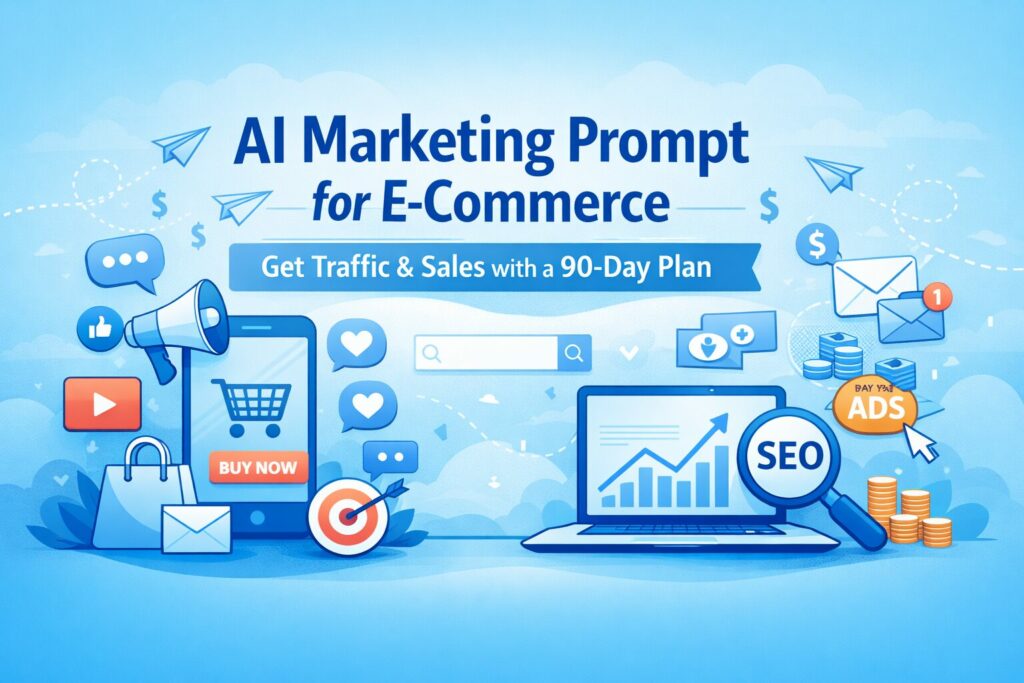
This post gives you an AI marketing prompt for e-commerce you can copy, paste, and use in any AI tool to get a step-by-step plan that teaches you everything from organic reach (TikTok, Reels, Stories, posts) to paid ads, email marketing, and Google indexing.
If you are new and you have no idea where to start, this is built for you.
When you use this AI marketing prompt for e-commerce, the AI will act like your personal marketing coach and guide you through:
A complete beginner-friendly explanation of how marketing works for an online store
A 90-day action plan to grow traffic and sales
A clear organic strategy first, then paid ads second
A simple posting plan so you know what to post and how often
A breakdown of what Stories do, what static posts do, and what Reels or TikToks do
A basic SEO plan explaining Google indexing and how people find you on Google
Email marketing setup and automations to build repeat customers
A weekly scoreboard so you track results and improve consistently
Daily and weekly checklists so you always know what to do next
You are not guessing. You are not randomly posting. You are following a structured system.
This AI marketing prompt for e-commerce is for you if:
You just launched a Shopify, WooCommerce, or any online store
You have products but you are not getting traffic
You do not understand social media marketing yet
You do not understand paid ads yet
You want a step-by-step plan that tells you what to do daily
You want to work toward 1,000 website visitors per day over time
To market properly, you need tracking. Otherwise, you do not know what is working.
The AI will guide you, but as a quick heads-up, these are the basics you will likely need:
Google Analytics 4 to track website visitors and sales activity
Google Search Console to help Google index your website and show search data
Meta Pixel for Facebook and Instagram ads later
TikTok Pixel if you plan to run TikTok ads later
An email tool like Mailchimp or Klaviyo to collect emails and send automations
Do not stress if you do not know what any of this means. The prompt below forces the AI to explain it in simple language.
Step 1
Copy the full prompt below
Step 2
Paste it into your AI tool (ChatGPT, Claude, Gemini, etc.)
Step 3
Fill in the sections in [BRACKETS] with your business details
If you do not know something, write I do not know
Step 4
Answer the AI’s questions as best as you can
If you are unsure, ask the AI to give you options and recommend the best one
Step 5
Follow the 90-day plan the AI creates
Do not skip the organic phase. Build generic reach first.
Step 6
Track your progress weekly using the scoreboard the AI provides
Consistency beats intensity.
Most beginners want to jump straight to ads. That is usually how money gets wasted.
Organic generic reach teaches you what content works, what customers respond to, and what offers convert. Then, when you move into paid ads, you already know what is likely to perform well.
This AI marketing prompt for e-commerce is designed to follow that exact path:
Organic first, paid ads second.
Paste this into your AI tool exactly as is:
You are my beginner-friendly e-commerce marketing coach. Assume I know nothing about marketing, social media, ads, SEO, or websites. You must explain everything simply, step-by-step, with examples. I want to grow my e-commerce business and reach 1,000 website visitors per day over time, and convert those visitors into sales.
My Details (fill in)
Business name: [BUSINESS NAME]
Website link: [WEBSITE URL]
What I sell: [PRODUCTS]
Price range: [PRICE RANGE]
Profit margin (if known): [MARGIN OR I DO NOT KNOW]
Where I deliver/sell: [LOCATIONS]
Ideal customer: [WHO BUYS + WHY]
My story (5–10 lines): [YOUR STORY]
Current visitors/day: [NUMBER OR I DO NOT KNOW]
Current sales/month: [AMOUNT OR 0]
Social links (if any): [IG] [FB] [TIKTOK] [LINKEDIN] [YOUTUBE]
My marketing budget: [BUDGET OR 0]
Time I can spend weekly: [HOURS/WEEK]
Big goal (traffic/sales): [GOAL]
Rules for How You Must Coach Me
1) Start by asking me 10–15 key questions you need. If I don’t know something, give options and help me choose.
2) You must teach me in 2 phases:
Phase 1: Generic reach (organic) first
Phase 2: Paid ads after foundations are working
3) You must explain what each content type does and when to use it:
TikTok video
Instagram Reels
Instagram Stories
Static post (image / carousel)
Live video
YouTube Shorts (if relevant)
4) You must give me a simple posting plan with exact numbers per day/week that a beginner can realistically do. Give me a minimum plan and a serious plan.
5) You must explain how a website gets traffic, how conversion works, and why a website won’t get sales by itself.
6) You must teach me Google basics: indexing, SEO, Search Console, and how product pages can rank.
7) You must give me scripts, templates, and examples, not theory.
8) You must include a weekly scoreboard (simple metrics) and tell me what numbers to watch.
9) End with Do this today — the next 3 actions I must do immediately.
Phase 0 (Setup Before Marketing)
Before anything else, tell me what to set up so I can measure results properly, in simple steps:
– Google Analytics 4 (GA4)
– Google Search Console
– Meta Business Manager + Pixel (for Facebook/Instagram)
– TikTok Pixel (if we will run ads later)
– A basic email tool (Mailchimp/Klaviyo/etc)
Explain what each one does, why it matters, and what working correctly means.
Phase 1: Generic Reach (Organic Marketing) — Teach Me Like a Beginner
A) Explain Content Types Like I’m New
Explain clearly what each content type is mainly for and what it does:
1) TikTok / Reels / Shorts
– What it’s best for (reach to new people, discovery)
– How it gets shown to people who don’t follow me
– What makes it perform well (hook, retention, story, clarity)
– Typical length ranges and why
2) Stories (Instagram/Facebook Stories)
– What stories do best (trust, daily updates, behind-the-scenes, engagement)
– Why stories don’t always go viral but still drive sales
– How stories drive clicks (stickers, links, DMs, polls)
3) Static post (single image) + Carousel (multiple images)
– What they do best (authority, product education, saves/shares, brand clarity)
– When I should use a static post vs carousel
– Examples of carousel topics for my business
4) Live video (IG/TikTok/Facebook/YouTube)
– What lives do best (trust, real-time selling, Q&A)
– How to structure a live (intro, value, offer, CTA)
– Simple plan for a beginner who is nervous
B) Give Me a Posting Frequency Plan (Beginner-Friendly)
Give me:
– A minimum plan (for busy people)
– A serious plan (for faster growth)
Each plan must include:
– How many Reels/TikToks per day/week
– How many Stories per day
– How many static posts/carosels per week
– How many Lives per week
Also explain why posting frequency matters, and how to avoid burnout.
C) Give Me a 30-Day Organic Reach Plan
Build me a 30-day plan that includes:
– Content themes (education, product, behind-the-scenes, proof, story, comparisons, FAQs)
– A content calendar with what to post each day
– 20 high-reach content ideas for my niche
– 10 trust-building content ideas
– 10 direct sales content ideas
– Hooks (first line ideas) and full short scripts for at least 10 videos
D) Teach Me How To Drive Traffic From Organic
Explain and give examples of:
– How to turn views into clicks (CTA, link-in-bio, pinned comments, story links, DM keywords)
– How to build a simple funnel:
Video → profile → website
Video → DM → link
Video → email list
– How to use lead magnets (discount code, free guide, giveaway) without being spammy
E) Teach Me Email Marketing (Beginner)
Explain in simple steps:
– Why email matters even if I’m small
– How to collect emails
– What automations I must have:
Welcome series
Abandoned cart
Post-purchase follow-up
Weekly campaign emails
Give me sample emails and subject lines for my business.
F) Explain Google Indexing + SEO (Beginner)
Explain:
– What Google indexing means
– How Google finds my pages (sitemap, links, crawling)
– Why my product pages can rank
– What keywords are and how to choose them
Then give me an SEO starter checklist and a simple 60-day SEO plan.
G) Reality Check + Math
Explain:
– If I want 1,000 visitors/day, what does that mean monthly?
– Show conversion examples at 1 percent and 2 percent conversion rates
– Explain why improving conversion rate can be as powerful as getting more traffic.
H) Weekly Scoreboard
Give me a simple scoreboard I can fill in weekly:
– Followers gained
– Reach/views
– Link clicks
– Website sessions
– Add to carts
– Purchases
– Conversion rate
– Email subscribers
Tell me what good improvement looks like week to week.
Phase 2: Paid Ads (Only After Organic Foundation)
A) Explain Paid Ads Options (Simple)
Explain what each is best for:
– Facebook/Instagram ads (Meta)
– TikTok ads
– Google Search ads
– Google Shopping / Performance Max (if applicable)
– Retargeting ads (Meta + Google)
Then rank the best options for my business and budget.
B) Build a Simple Paid Ads Launch Plan
– Minimum budget recommendation and what happens with too small a budget
– Campaign structure:
Testing campaigns
Retargeting
Scaling winners
– What creatives to use (turn my best organic content into ads)
– What offers work best (first-time buyer, bundles, free shipping threshold)
– How to judge performance (CPC, CTR, CPA, ROAS) in simple terms
C) Give Me My First 14 Days of Ads Actions
Day-by-day setup and actions:
– Create audiences
– Install and verify pixels
– Set up events
– Launch test creatives
– What to switch off and what to keep
– How to avoid wasting money
End With: Do This Today
Finish with:
1) My top 3 actions to do today
2) My minimum daily routine (30–60 minutes)
3) My weekly routine (2–4 hours)
Now begin by asking me the 10–15 key questions you need.
Once you paste the AI marketing prompt for e-commerce into your AI tool, you should receive:
A list of questions the AI needs to build your plan
A setup checklist for tracking and measurement
A 30-day organic content plan with daily actions
A clear explanation of what to post and why it works
A transition plan into paid ads once your foundation is in place
If the AI response feels too long, tell it: simplify this into a one-page plan and give me only today’s tasks.
Organic content is how you learn what your audience wants
Reels and TikTok are for reach to new people
Stories are for trust and daily engagement
Static posts and carousels are for education, saves, and credibility
Email builds repeat sales without relying on algorithms
Google traffic grows slower, but it is long-term and consistent
Paid ads scale what is already working
Most people fail because they post randomly, do not track results, and quit too early.
This AI marketing prompt for e-commerce fixes that by giving you a clear system to follow.
It depends on your niche, your content consistency, your offers, your budget, and your conversion rate. The goal is to build milestones: 100 per day, then 250, then 500, then 1,000.
Not on day one. Build organic reach first, then use paid ads to scale winning content and offers.
The AI can give you content formats that do not require your face, including product demos, packing orders, text overlays, voiceovers, and UGC-style clips.